

Many people start their immigration research with one number: approval rate. It is simple. It feels objective. It sounds like a shortcut to certainty.
But the USCIS does not adjudicate averages. The USCIS adjudicates your file.
That is why approval rate alone is not the metric that matters most. In today’s immigration landscape, there is another metric that tells you far more about how a law firm practices and how your case will be handled when it gets difficult.
That metric is resilience.
What happens when the USCIS issues an RFE or NOID
Resilience is what happens when your strong case hits real scrutiny — an RFE (Request for Evidence), a NOID (Notice of Intent to Deny), or even a denial.
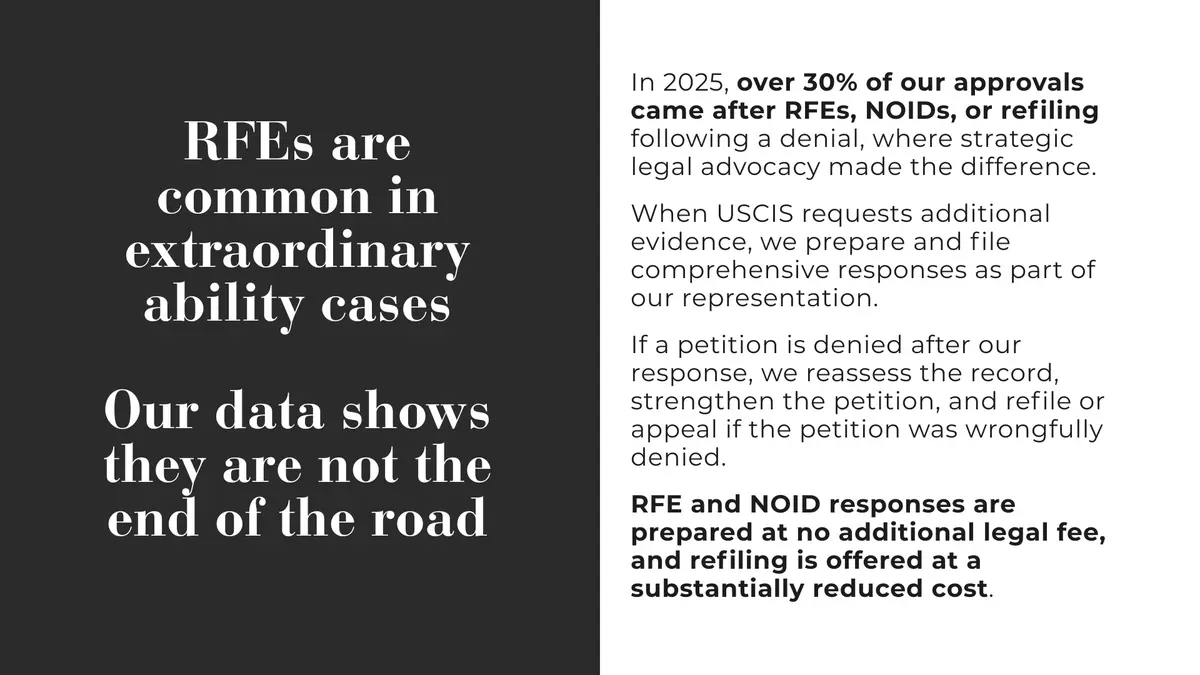
Many people assume these outcomes are rare or mean the case was weak. That is not always true. EB-1A, EB-2 NIW, and O-1A cases are discretionary. Officers vary. Standards shift. Documentation expectations evolve. A well-prepared case can still receive an RFE or NOID.
What matters is what your counsel does next.
- Do they know how to build the record further, not just argue?
- Do they have a structured RFE response process?
- Do they invest attorney time into the response, or treat it as an afterthought?
- Do they give you a plan that is honest about risk and realistic about next steps?
Resilience is the difference between panic and progress.
Our 2025 EB1A, EB2 NIW, and O1A case outcomes
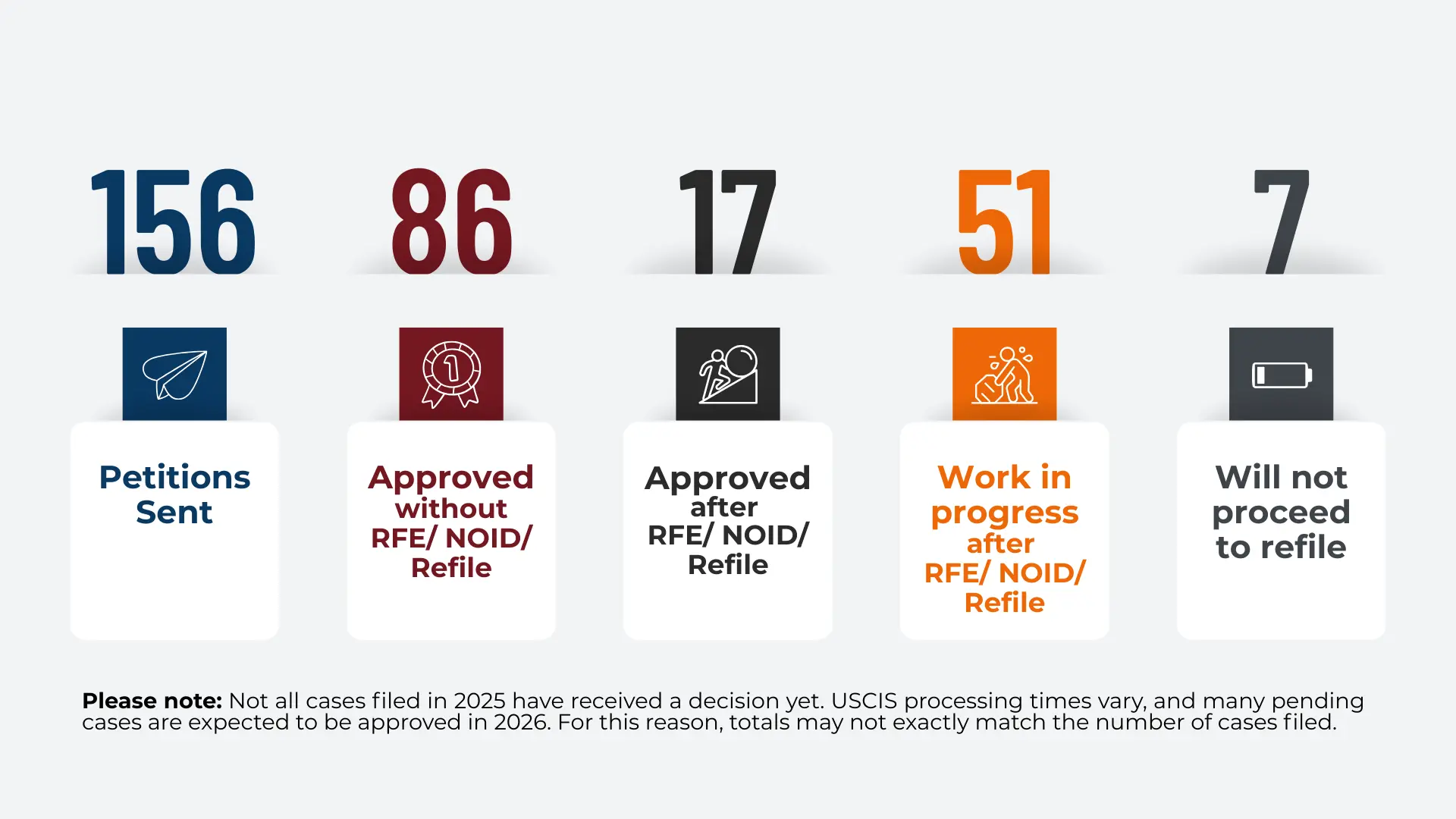
In 2025, our team filed 156 petitions across EB-1A, O-1A, and EB-2 NIW. 86 were approved without an RFE, a NOID, or a refiling. 17 were approved after deeper advocacy through an RFE, a NOID, or a refiling. 51 are currently in progress at that stage.
When we look at our internal data, over 30 percent of our approvals came after extra scrutiny. In those cases, legal strategy made the difference.
This is why the right question is not only “What is your approval rate?” A better question is: what happens when the USCIS challenges the case?
Why approval statistics can be misleading
Approval rates can be technically correct and still misleading. Not because the number is wrong, but because the number is incomplete.
Here are the most common reasons:
The “denominator” problem in immigration approval rates
Some firms calculate approval statistics by mixing in routine filings where approval is close to automatic. These can include filings such as I-485, I-539, or other routine applications. Adding them inflates the headline number but tells you very little about how the firm performs on discretionary petitions like EB1A, EB2 NIW, and O1A.
Pending cases are sometimes treated as wins
Some firms count cases that are still pending as “successful,” “expected to win,” or “on track.” That may sound optimistic, but it is not a final outcome.
We do not do that.
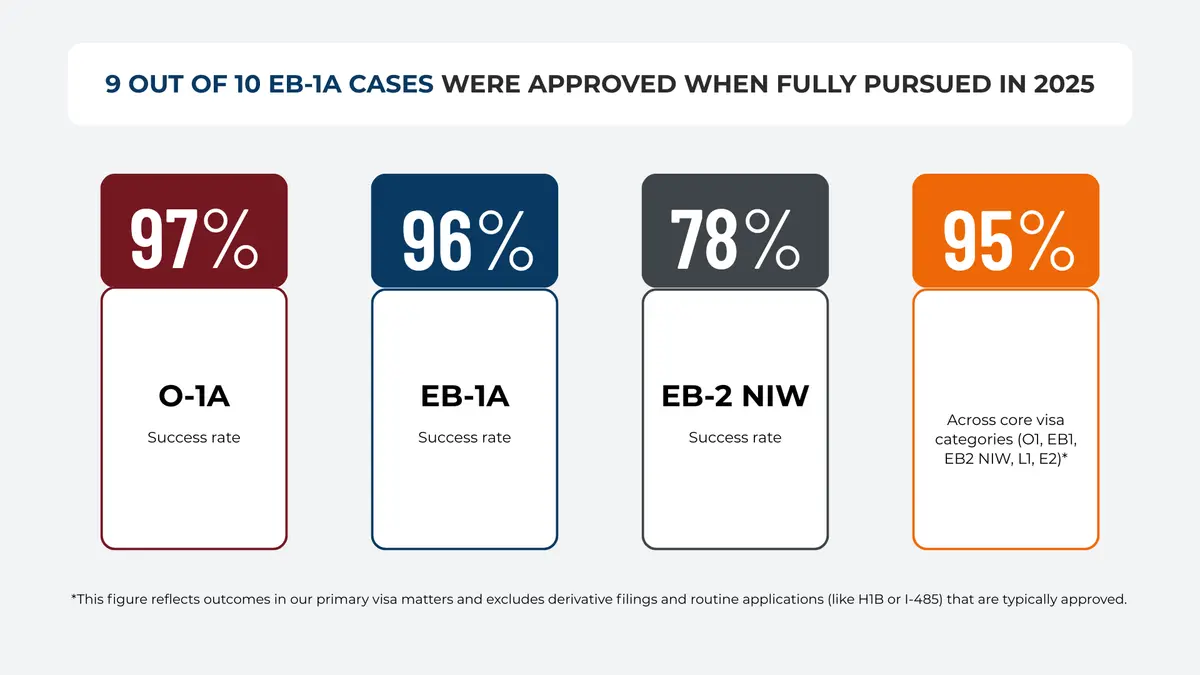
We report final outcomes for the types of petitions where legal strategy matters. We only count a case as successful when it is approved. Cases that are pending remain in the “in process” category until the USCIS issues a decision. That is how statistics stay honest.
Any attorney promising 90% or 95% odds for your specific case is only guessing. There is too much USCIS discretion and too many variables for anyone to “guarantee” outcomes.
What to ask before hiring an EB1A, EB2 NIW, or O1A lawyer
If you are choosing counsel for an extraordinary ability or national interest case, ask questions that reveal process, not marketing.
RFE and NOID response process
When the USCIS issues an RFE or NOID, what is the firm’s process for preparing the response? Do they begin with a structured plan? Do they map each request to exhibits? Do they strengthen the record with new documentation? Or do they mainly argue?
Whether the RFE response is included in the fee
Is the RFE or NOID response included in the attorney fee, or billed separately? If billed separately, do they charge per hour?
A properly prepared RFE or NOID response often takes substantial attorney time. If a firm quotes a low fee but bills heavily later, you should understand that before you sign.
What happens after a denial
If the case is denied, do they reassess, strengthen, and refile at a reduced cost? Or is it a full restart at full price?
Denials happen. What matters is whether the firm has a responsible strategy to move forward.
Want a realistic assessment of your EB1A, EB2 NIW, or O1A chances? Stelmakh and Associates will review your profile, identify the strongest criteria strategy, and explain the exact evidence plan we would build for the USCIS. If you decide to move forward, you get a team that is prepared for scrutiny and committed to finishing the case the right way.