

Big changes may be on the way for the H-1B visa system. The Trump administration has proposed a sweeping change: abolishing the pure random lottery and replacing it with a wage-weighted selection system that offers significantly higher odds for jobs with higher wages.
However, as with all regulatory changes, it’s not set in stone. It must pass through the rulemaking process, withstand public comment, and potentially face legal challenges. Here’s what we know so far, how it likely works, and what it means for workers and employers.
Changes: From Lottery to Weighted Chances
Under the current system, if H-1B registrations exceed the annual cap, USCIS runs a random lottery, where each registration has equal odds (regardless of wage, job level, or employer). That could soon change.
The new proposal would weight selection odds based on wage level (determined by the Department of Labor prevailing wage tiers) instead of treating all registrations equally.
Here’s how the weighting is expected to work:
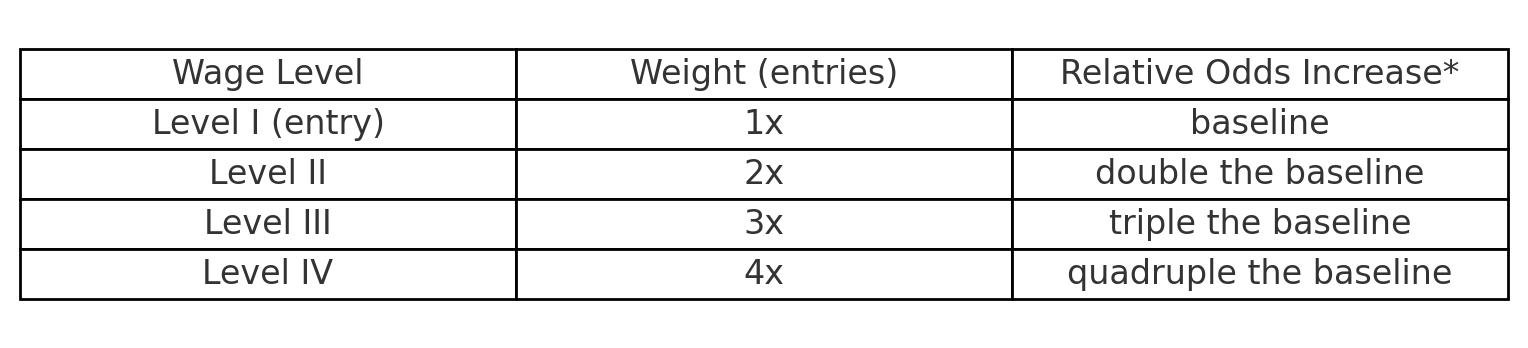
In reality, the odds will depend on:
- How many people fall into each wage level.
- How many visas are available.
- Whether a sub-lottery has to be run inside a wage level.
So, a registration at Level IV would enjoy 4x the “entry weight” compared to Level I, giving substantially better odds of being selected.
If an entire wage level has more registrations than available visas, a sub-lottery within that level would be used to break ties — but only within that bracket.
Timeline & Rulemaking Status
- The DHS/USCIS proposed this rule under the name “Weighted Selection Process for Registrants and Petitioners Seeking To File Cap-Subject H-1B Petitions” (RIN 1615-AD01).
The rule has cleared internal review, including the Office of Information and Regulatory Affairs (OIRA), as of August 2025. - If approved in time, the new system could begin applying for FY 2027, i.e., for registrations submitted in March 2026.
So far, the framework is set; the details (how exactly weights are computed, how tie-breakers will work, and interaction with advanced-degree exemptions, etc.) remain to be published.
What That Means: Winners, Losers, and Strategies
Let’s keep in mind the upcoming $100,000 H-1B fee (effective soon) and the wage-weighted lottery proposal (likely starting with FY 2027, but not yet guaranteed) to paint the future landscape of the U.S. job market.
What The New Rules Mean For Workers
- Entry-level professionals face challenges. Level I wage roles carry the lowest odds under the proposed wage-weighted lottery, and employers must also weigh whether an early-career hire is worth a $100,000 filing fee. For many F-1 students graduating into the U.S. workforce, the traditional H-1B pathway will be much harder to access. The best way here is to aim for cap-exempt employers or companies with stronger pay scales and negotiate for higher wages when possible.
- Workers in higher-paid positions (Levels II–IV) may still have viable chances, since employers can better justify both the fee and the improved lottery odds.
- Alternatives like the O-1A visa or self-petitioned green cards (EB-1A, EB-2 NIW) will become increasingly important for talented individuals whose employers hesitate at the new costs. The USCIS may become overwhelmed with the extraordinary petitions soon. If you think you qualify, it’s better to start the process ASAP.
What The New Rules Mean For Employers
- Immigration budgets will need recalibration. The $100,000 per H-1B filing forces companies to reserve sponsorship for high-value roles where the return justifies the expense.
- Startups, smaller firms, and employers in sectors with modest prevailing wages will likely step back from H-1B filings altogether.
- Cap-exempt institutions such as universities, nonprofit research bodies, and government research organizations gain a new competitive edge, since they are not subject to either the $100,000 fee or the lottery.
What The New Rules Mean For the System Overall
- The H-1B program is shifting from a general work visa option to a more elite, high-salary pathway. High-wage workers and well-resourced employers will dominate filings, while junior professionals and smaller businesses may be squeezed out.
- The $100,000 fee is now official, while the wage-weighted lottery remains a proposal that is most likely to be implemented starting with the FY 2027 season (registrations in March 2026). Until the regulation clears the rulemaking process, uncertainty remains.
- Expect lawsuits challenging the legality of both the fee and the restructured lottery, as core visa categories are established by Congress, not by executive order.
- The public comment period opened on September 24, 2025, and will continue for 30 days; we encourage you to participate. If finalized, implementation would likely apply to the fiscal year (FY) 2027 H-1B cap season beginning March 2026.
How to Make Your Voice Heard
The Department of Homeland Security officially opened the public comment period on September 24, 2025, and it will remain open for 30 days. This is the only window for employers, workers, and the public to provide feedback on the proposed wage-weighted H-1B lottery. Every comment submitted is reviewed and becomes part of the public record before the rule can move forward.
How to Submit a Comment:
- Go to the Federal Register website, the proposed rule is titled “Weighted Selection Process for Registrants and Petitioners Seeking To File Cap-Subject H-1B Petitions” (DHS/USCIS, RIN 1615-AD01).
- Click “Submit a Public Comment” and follow the prompts.
- You may submit as an individual or on behalf of your organization. Comments can be as short or as detailed as you like, but they should be respectful, constructive, and specific.
Tips for Writing an Effective Comment:
- Be clear and specific. Explain how the rule would affect you personally or your business. For example, if you are an F-1 student facing Level I wages, describe how the change could block your ability to remain in the U.S. workforce. If you are an employer, outline how the $100,000 fee or wage-based lottery would impact your hiring plans.
- Provide evidence where possible. Reference data, real-world examples, or comparisons to existing programs.
- Offer alternatives. If you disagree with the proposal, suggest other approaches (e.g., tiered fees, exemptions for startups, or broader cap-exempt categories).
- Keep it professional. Comments become part of the public record and can influence how the rule is finalized.
- Deadline. Comments must be submitted by October 24, 2025.
Taking a few minutes to submit a comment ensures that your perspective is counted before these sweeping changes are finalized.